As ever, the core value proposition for sound money proponents remains firmly rooted in permissionless settlement capabilities and real economic network activity.
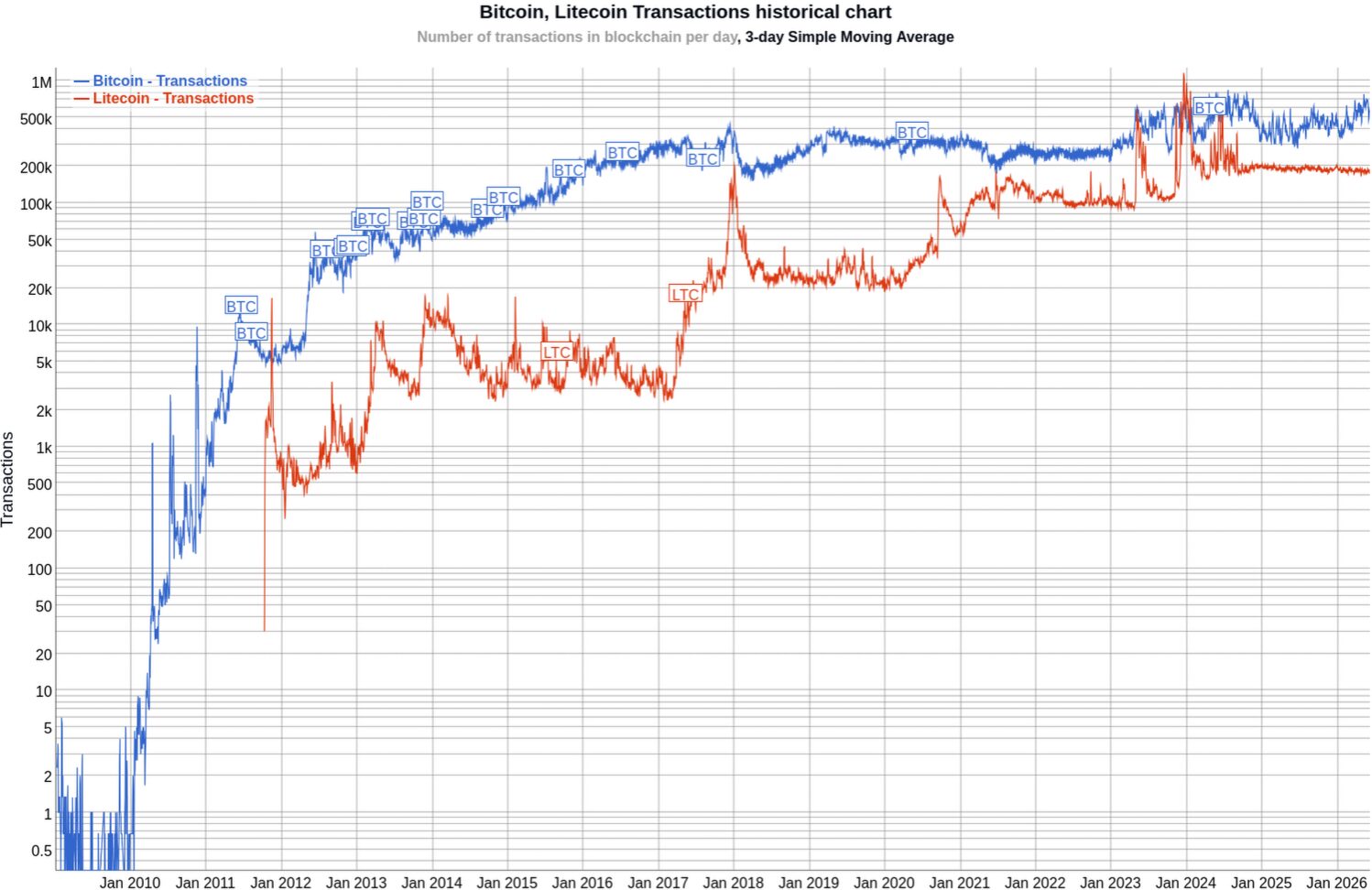
One crucial piece of evidence that buttresses expectations for structural repricing of Litecoin lies in the converging trends of the two dominant networks since at least 2017, which remain resilient despite high fiat-price volatility.
User migration to the Litecoin network
Over the last ten odd years, the Litecoin main chain has experienced a staggering increase in sustained daily transaction activity. Now consistently registering around 200,000 transactions each day, this growth contrasts with Bitcoin’s modest increase to approximately 500,000 transactions per day – effectively doubling over that same period.
The reason for this migration is simple: as demand for permissionless block space increases, the cost of using the Bitcoin network surges too. During peak usage times, users prefer migrating to a more cost-effective chain than paying $120 just to get a transaction confirmed – an untenable proposition for everyday spending.
By contrast, Litecoin’s 2.5-minute block times and its Scrypt algorithm keep things chugging along with the lowest of budgets. Even when the network is busy, a transaction will typically cost less than a cent, making it a far more sensible option.
The key takeaway is that increasing Bitcoin usage reliably encourages migration to the Litecoin network, and one need only look at on-chain data to verify the trend. This means that over time, lower and mid-value transactions systematically migrate to Litecoin, as evidenced by data from bitinfocharts.
Asymmetric value
Today, Bitcoin has solidified its position as a permissionless settlement network and store of value for large transfers.
At the same time, Litecoin has evolved into the preferred network for everyday payments and smaller transactions, functioning as “digital silver” to Bitcoin’s “digital gold.”
However, despite these coalescing trends and comparable fundamentals, at $3.9 billion, Litecoin’s market capitalisation is around 0.25% that of Bitcoin’s $1.2 trillion, even though the data show that the speculative premium on one makes little sense in light of the other.
The market capitalisation disparity makes Litecoin’s value proposition all the more intriguing given that the two networks have essentially interchangeable purposes and first principles, and sustained real economic moats.
Bear in mind, Litecoin has neither a marketing department, nor a Saylor-type venture-capitalist gang actively cheer-leading the coin.
The distinction matters because it speaks to the underlying cohort of users who have shown consistent confidence by choosing Litecoin over other networks, regardless of the speculative price-tag.
These truisms haven’t gone unnoticed. As evidenced by the growing cohort of litecoin financial products and capital flows directly into these instruments, institutions have noticed too and are continuously accumulating coins.
Take a look at litecoin:native investment and treasuries excluding Grayscale Litecoin Trust $LTCN and LiteStrategy $LITS. Increasing at a rate of ~Ł100k per year. Latest updates: https://t.co/2kkMABSHrd pic.twitter.com/WTGiPxwHTk
— litecoinregister (@litecoinfan456) June 7, 2026
The path of least resistance
Litecoin’s shared foundation with Bitcoin, its robust decentralised infrastructure and longevity – having survived and operated continuously since 2011 without a single network failure – provides a level of security and reliability that newer, more experimental chains cannot match.
In turn, this makes it the default, lowest-risk alternative for users and capital seeking to escape both Bitcoin’s congestion and speculative bloat relative to the only proven alternative in town.
As the second Bitcoin chain, every new Bitcoin user indirectly strengthens Litecoin’s case for monetary adoption, cementing its role in the wider economy.
If you found this article useful, consider sharing it.